Rural depopulation and agrarian change
Tess of the d'UrbervillesRural depopulation and agrarian change in Wessex form a connected process: workers move between farms with the hiring year, while the contraction of village housing and the disappearance of independent livelihoods push established rural families toward larger towns or precarious displacement. The novel gives this transformation a human scale through Marlott’s diminishing community, the Durbeyfields’ eviction, and the contrasting wagons that carry hired laborers and the unwanted family away.
Seasonal Mobility and the Changing Work Year
At Old Lady-Day, the agricultural world enters a yearly upheaval. Agreements for outdoor service made at Candlemas come due, and laborers who will not remain in their old places move to new farms. This is not presented as an isolated disturbance but as an increasingly common pattern: workers who once spent their lives on one farm, often following the same attachment as their parents and grandparents, now change places more frequently. For younger families, moving can bring excitement and the prospect of advantage, but the narrator’s migration metaphor unsettles any simple idea of progress. One family’s Egypt may look like another’s Promised Land from a distance; after settling there, it too can become Egypt, prompting another move.
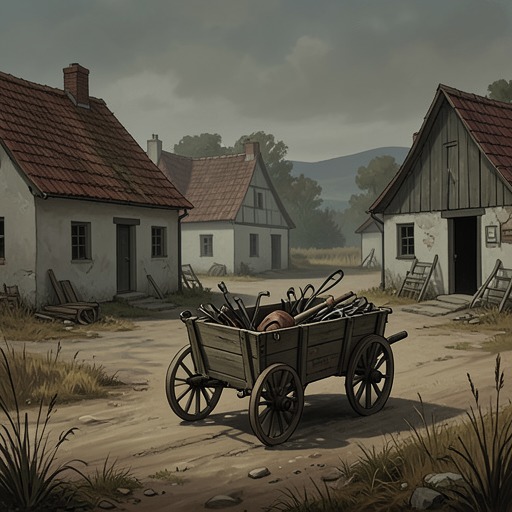
The annual circulation of labor is accompanied by a different, less voluntary movement: the departure of people whose livelihoods and homes are being removed from the countryside. The seasonal wagons rumble along the highways before daylight, sent by farmers to collect the goods of men they have hired. Their early start is practical, allowing the outgoing household’s belongings to be loaded by six in the morning and the transfer to be completed within the day. The sound marks the labor system’s regular rhythm, but it also throws into relief who qualifies for assistance and who does not.
The Hollowing Out of Marlott
The novel distinguishes the agricultural laborers from a more stable village population that once stood above them in local standing: carpenters, smiths, shoemakers, hucksters, and other workers not directly employed on the land. Some were lifeholders or copyholders; a few were small freeholders. Their security rested partly on forms of tenure that gave them a lasting place in village life. As long holdings fell in, however, they were rarely granted again to comparable tenants. Houses were pulled down unless a farmer needed them for workers, and cottagers without direct employment on the land were treated unfavorably.
The result is not simply that individual households lose their homes. The departure of one family reduces the trade available to others, compelling further families to leave. People who had carried village traditions and formed what the narrator calls its backbone seek refuge in larger centers. The account pointedly rejects the benign official phrase for this movement, the tendency of rural population toward large towns: it compares the process instead to water being forced uphill by machinery. The image makes clear that the movement is driven rather than natural, and that the choice of destination does not erase the pressure that made departure necessary.
Labor, Machinery, and Rural Hardship
The changing countryside is also shown at the level of bodily work. At Flintcomb-Ash, a farm described as a starve-acre place, Tess and Marian hack the lower, earth-covered halves of swedes left after livestock have eaten the tops. Their field stretches across more than a hundred acres on high ground, where loose white flints lie among the chalk. With every leaf already consumed, the land appears exhausted; the workers’ task is to recover what remains. The setting connects agricultural production to the condition of the people assigned its hardest labor: they work over depleted ground in a place whose poverty is built into its description.
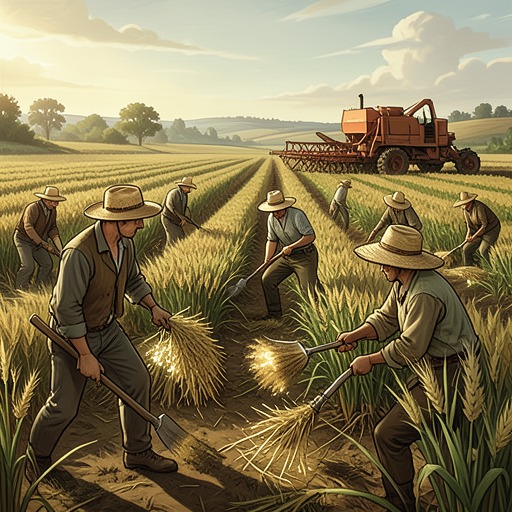
Mechanization does not eliminate this hardship; it reorganizes and intensifies it. At the threshing, Tess stands on the machine’s platform beside the feeder, untying each sheaf passed to her by Izz Huett. Once the drum is running, the feeder cannot stop, and Tess cannot stop unless Marian exchanges places with her. Farmer Groby has chosen her because she combines strength, quickness, and staying power, qualities that make her useful for a task demanding relentless supply. Older men recall threshing by flail on the barn floor and prefer the slower hand process, while the machine’s continuous hum and revolving drum govern the pace of the workers around it. The episode gives technological change a precise social form: the machine’s speed is sustained by human bodies, and a woman’s endurance becomes part of its operating capacity.
Eviction and Unequal Mobility
The Durbeyfields’ eviction from Marlott occurs within the larger contraction of village accommodation. As cottages are demolished, the houses left standing are needed by farmers for their workpeople. The family has also become an object of local moral judgment after the event that altered Tess’s life; the village is described as wanting to preserve its purity, and the Durbeyfields are tacitly regarded as a household that should go when its lease ends. On the first Lady-Day when they can be expelled, their roomy home is required for a carter with a large family. The family’s removal thus brings economic demand and moral exclusion together: their house is needed, but they themselves are not.
The difference between hired workers and the Durbeyfields becomes visible in the vehicles that set out from the inn. Marian, Izz Huett, and the ploughman’s family travel in a brightly painted wagon drawn by three powerful horses with shining brass harness ornaments. Their wagon represents employment that has made a place for them at another farm. The Durbeyfields, by contrast, ride in a creaking, unpainted vehicle drawn by only two horses, which they have had to hire at their own expense because no farmer has sent a team for them. The contrast is not merely one of comfort. It separates workers being conveyed to a job from women and children who are not regular laborers and are not particularly wanted anywhere.
Their journey is too long for a single day, and the horses struggle to cover the distance. Late in the afternoon, the family reaches the upland near Greenhill and looks toward Kingsbere, the ancestral home John Durbeyfield had repeatedly invoked. The destination carries the promise of inherited belonging, but the family arrives there as displaced people, not as returning owners. Rural change therefore cuts across both present employment and the imagined security of ancestry: the name and the old family seat cannot supply a house or a livelihood.
Family Survival and the Costs of Displacement
The novel links rural insecurity to the labor of maintaining a household. Tess’s family depends on the decisions of its two adult heads, while the younger children have no control over the conditions in which they must live. Tess assumes a deputy-maternal role when left alone with them, and the narrator depicts the children as passengers carried into hardship without having chosen the voyage. The image places household vulnerability within the same structure as rural displacement: those least able to determine where a family goes are still compelled to bear the consequences.
That burden continues through Tess’s working life. After returning to harvest work, she takes her infant from her sister during the midday break and suckles the child while the other harvesters eat. Later, separated from Angel Clare and short of money, she sends her mother twenty pounds toward the cost of replacing the leaking thatch and repairing rafters and an upstairs ceiling. Of thirty pounds due from Angel’s bankers, the remainder must also cover winter clothes, leaving only a nominal sum for the season. These distinct pressures—care work, field labor, and money sent back to a household in distress—show how the costs of keeping rural families alive fall heavily on women even as their own security remains precarious.
Marlott’s decline is therefore not just a backdrop to personal misfortune. Seasonal labor migration, the loss of long-held tenancies, the demolition of cottages, the withdrawal of village trades, and the selective allocation of transport and employment all narrow the means by which people can remain in place. The Durbeyfields’ departure concentrates these changes into one visible scene, but the broader pattern is collective: families move because farms and housing have been reorganized around the needs of landowners and agricultural employers, while those without a secure claim to either work or property are left to carry the cost of the transformation.